
Why BMS Data isn’t Enough
Summary
BMS data tells you what the system is doing. It doesn’t tell you how air is actually behaving. Most cooling issues—bypass, recirculation, uneven airflow—happen at the rack level, where BMS visibility is limited or nonexistent. Spot checks fill that gap. They show what sensors miss and confirm whether your cooling is working in practice, not just on paper.
BMS Data Shows the System—Not the Outcome
A Building Management System is built to monitor equipment, not airflow behavior. It tracks supply and return temperatures, setpoints, and alarms—useful signals that tell you whether your infrastructure is operating as expected. But it doesn’t answer the question that actually matters: is cold air reaching the servers?
What BMS typically captures:
Supply and return temperatures
Cooling unit performance
Setpoints and alarms
Overall room trends
All of this reflects system activity, not whether airflow is doing its job at the rack.
Airflow Problems Don’t Show Up at the Room Level
Most BMS sensors are installed in fixed, predictable locations—near cooling units or in return air paths. They provide a partial view of the room, but not the full picture.
Airflow problems don’t happen in those locations. They happen in between, where air interacts with racks, gaps, and containment.
Where issues actually occur:
At specific racks
Within individual aisles
Around small physical openings
Because these problems are localized, they rarely show up clearly in centralized data.
Averages Hide the Real Problem
BMS data often appears stable because it reflects averages across the space. But airflow is not uniform, and averages smooth out the variation that actually matters.
You can have one rack running hot, another overcooled, and a third behaving normally—all within the same row. The system reports a comfortable average, while individual conditions vary widely.
This is why issues feel inconsistent. The data looks steady, but the environment isn’t.
What averages tend to hide:
Localized hot spots
Uneven airflow distribution
Rack-to-rack temperature variation
The problem isn’t randomness. It’s lack of visibility.
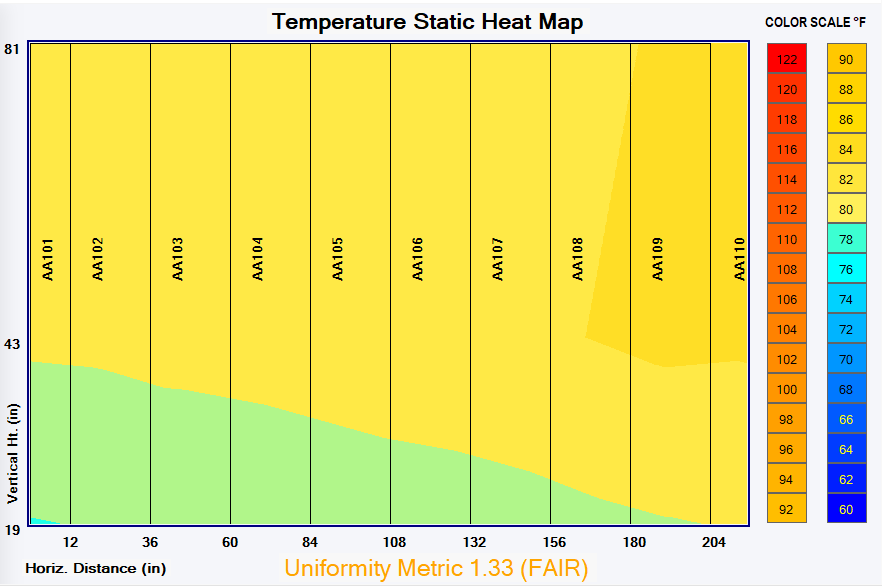
Spot Checks Show What’s Actually Happening
Spot checking shifts the focus from system-level data to rack-level conditions. It’s a simple process—measure inlet and exhaust temperatures directly, across multiple points—and it immediately reveals how air is distributed.
Instead of relying on assumptions, you can see how airflow behaves in real time.
What spot checks uncover:
Which racks are starved for air
Where recirculation is occurring
Where cooling is being wasted
It turns a “stable” system into something you can actually understand.
Spot Checks Validate Assumptions
Most facilities operate on a set of assumptions about cooling performance. Those assumptions are often based on limited data and past experience, not direct measurement.
Spot checks allow you to test those assumptions. They show whether airflow is consistent, whether temperatures are aligned across racks, and whether the system behaves the way you expect.
In many cases, the results challenge what operators thought was true.
What you can confirm:
Whether cold air reaches all racks
Whether temperatures are consistent
Whether airflow follows the intended path
Without this step, decisions are based on incomplete information.
This Isn’t About Replacing BMS
BMS data is still essential. It provides continuous monitoring, alerts, and long-term trends that are critical for operations.
But it only tells part of the story. To understand performance, you need to pair it with direct validation.
How the two work together:
BMS → system-level visibility
Spot checks → rack-level reality
One shows what should be happening. The other shows what is.
When to Spot Check
Spot checks don’t need to be constant, but there are clear moments when they add value. These are typically times when conditions have changed or when the system isn’t behaving as expected.
Even a quick walkthrough can reveal issues that would otherwise go unnoticed.
When it matters most:
After layout or load changes
When hot spots appear
After containment updates
During routine maintenance
The goal is not constant measurement—it’s targeted validation.
Final Takeaway
BMS tells you how your cooling system is running. Spot checks tell you whether it’s working.
If you rely on one without the other, you’re missing part of the picture. And in most cases, it’s the part that matters.
Want to Learn More on Monitoring ?
Check out these other Keep your Cool Articles or visit our learning resources page.


At Keep Your Cool, we often advocate for raising data center temperatures to improve efficiency and OpEx. However, as temperatures climb, so does the risk of heat-related illnesses for staff in hot aisles, exacerbated by high wattage servers, particularly those fueled by AI. Today, let's explore why measuring heat stress in these environments is crucial for both people and performance.